
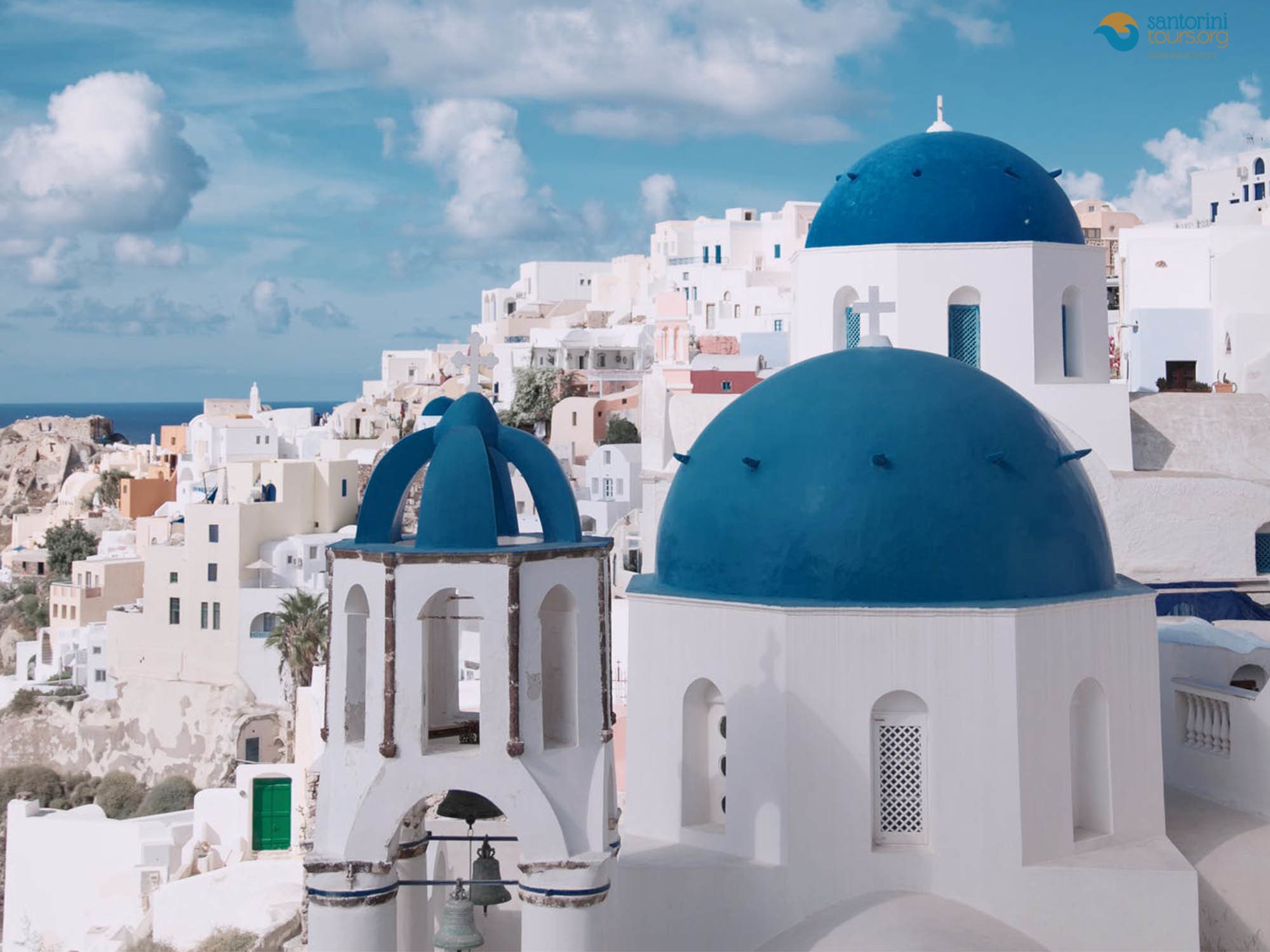
Santorini has been continuously inhabited for at least five thousand years, destroyed once completely, resettled, fortified against pirates, ruled from Venice, shaken flat by an earthquake and rebuilt into one of the most visited places in Europe. Almost none of that is visible from a viewpoint, and almost all of it explains what you are looking at.
This guide covers the island’s history and living culture: the Bronze Age town under the ash, the medieval castles, the Venetian centuries, the churches, the festivals and the traditions that survive. It also covers which santorini tours actually engage with any of it, and which drive past.
For travellers planning the island, santorini tours and santorini tours offer expertly guided experiences across Santorini — from caldera sunsets and volcano walks to private wine tastings and tailor-made sightseeing.
What History Do Santorini Tours Cover?
Akrotiri and the Minoan eruption, almost always. Everything after 1600 BC, almost never.
Standard full-day santorini tours include the buried Bronze Age town and a guide who explains the eruption. That is genuinely the island’s most significant story and it deserves the hour it gets.
What gets skipped is the three and a half thousand years since: Ancient Thera on its ridge, the medieval kastelia at Emporio and Pyrgos, the Venetian period, the wine-and-pumice economy, the earthquake. Santorini tours that include one inland village usually touch it in passing, and a private itinerary can cover it properly.
What Do Santorini Tours Show You At Akrotiri?
A town that stopped — streets, multi-storey buildings, drainage and pottery, preserved under volcanic ash.
The Akrotiri seen on santorini tours was a sophisticated Bronze Age settlement with paved lanes, indoor plumbing, imported goods from across the eastern Mediterranean and walls covered in frescoes. It was buried around 1600 BC and preserved by the same ash that ended it.
No bodies have been found, which suggests the population evacuated after warning tremors. The site is roofed, level and walkable in about an hour. Unguided it is a set of stone walls behind rope; guided it is a town with streets you can follow — which is the single strongest argument for taking santorini tours rather than exploring alone.
Why Do Santorini Tours Not Show The Frescoes?
Because they are not at the site — they are in the Museum of Prehistoric Thera in Fira.
The wall paintings missing from santorini tours are among the finest surviving Bronze Age art anywhere: boxing children, antelopes, a fleet of ships, a spring landscape with swallows. What makes them remarkable is how ordinary their subjects are — no kings, no warfare, no state propaganda.
The museum is small, air-conditioned and takes about an hour, and it roughly doubles the value of a visit to the excavation. Very few santorini tours build it in because it sits in Fira, where most itineraries only pass through.
Was Akrotiri Atlantis?
Possibly, and the theory is more respectable than it sounds.
Long before santorini tours, Plato described an advanced island civilisation destroyed in a single day and night and swallowed by the sea. A sophisticated Bronze Age culture on a circular island, obliterated when a volcanic collapse dropped its centre into the Aegean, is at minimum a striking match.
No archaeologist claims it as settled and the dates do not align neatly. But it remains the most plausible candidate anyone has proposed, and guides on santorini tours raise it because the parallel is hard to ignore while standing in the streets of the buried town.
Read more: Akrotiri Santorini Private Guided Transfers
How Did The Eruption Change The Aegean?
It generated tsunamis, dropped ash across the eastern Mediterranean, and probably contributed to the collapse of Minoan Crete.
Beneath santorini tours, ash layers from the Minoan eruption have been identified in seabed cores across the region and in ice cores far outside it, which is how the event is dated. Tsunami deposits have been found on the north coast of Crete, seventy miles south.
Minoan civilisation declined within decades and was absorbed by the Mycenaeans shortly after. The causal chain is debated; the coincidence is not. Santorini tours that connect the caldera to Crete’s decline give visitors the context that turns a scenic island into a historically consequential one.
What Is Ancient Thera And Do Santorini Tours Visit It?
A Greek and Roman city on the ridge above Kamari — and very few itineraries include it.
Rarely reached by santorini tours, Ancient Thera was founded in the ninth century BC by Dorian settlers and occupied into the Roman period. It spreads along the spine of Mesa Vouno at 350 metres, with an agora, a theatre, temples, houses and a gymnasium still traceable in the stone.
Where Akrotiri is buried and roofed, Ancient Thera is exposed and enormous, with the sea on both sides. It sees a fraction of the visitors and it needs requesting on a private itinerary. Among all the santorini tours available it is the most consistently underrated stop.
Who Ruled Santorini After The Greeks?
Romans, Byzantines, Venetians, then Ottomans — and the Venetians left the deepest mark.
Long before santorini tours, after the Fourth Crusade in 1204 the island passed to the Venetian Duchy of Naxos, and it is the Venetians who gave it the name Santorini — a contraction of Santa Irini, after a church they used as a landmark. Locally the island was and is called Thira.
Venetian rule brought the castle system, the Catholic community that still exists in Fira, and the wine trade that shaped the island’s economy for centuries. Santorini tours that stop at Pyrgos or Emporio are standing in that history whether or not it gets mentioned.
What Are The Kastelia?
Five fortified villages built against pirate raids, of which Emporio’s is the best preserved.
Read more: Agios Georgios Santorini Private Guided Transfers
On santorini tours a kasteli is a defensive settlement where the outer houses are built wall-to-wall to present a blank face to attackers, with a single gate and a tower at the centre. Santorini had five: Skaros, Pyrgos, Emporio, Akrotiri and Oia.
Emporio’s is the largest surviving example — a genuine maze of covered alleys and interlocking houses that is disorienting to walk in the best way. Pyrgos retains its castle and its spiral street plan. Skaros was abandoned after earthquakes. Very few santorini tours include Emporio, which is precisely why it is quiet.
What Happened At Skaros?
It was the island’s medieval capital until earthquakes made it untenable.
On santorini tours Skaros is the volcanic promontory below Imerovigli, and for several centuries it held the seat of government — a fortified settlement on a rock with the caldera on three sides, effectively impossible to storm.
Repeated earthquakes through the seventeenth and eighteenth centuries destabilised it and the population moved to Fira. What remains is the rock, a path down from Imerovigli and the small chapel of Theoskepasti on the far side. It is a fifteen-minute walk and the most dramatic short outing on the island; santorini tours rarely allow the time.
What Did The Earthquake Do?
Destroyed most of the caldera villages and emptied the island of half its population.
Long before santorini tours, the July Amorgos earthquake measured around 7.7 and devastated Santorini. Oia was largely destroyed, Fira badly damaged, and thousands emigrated to Athens, Australia and America in the decade that followed. The population fell from around twelve thousand to under seven.
Much of what visitors see in Oia today is careful reconstruction from the 1970s onward, financed by tourism. Guides on santorini tours mention it because it explains why a village that looks medieval is largely fifty years old.
What Was The Island’s Economy Before Tourism?
Wine, pumice and tomatoes — all three exported, all three now essentially gone.
Before santorini tours the island exported bulk wine across the Black Sea and the Mediterranean for centuries. Volcanic pumice was quarried on the northern coast and used in construction, including the Suez Canal. And the small, intensely sweet local tomato was processed into paste at canneries along the south coast.
The tomato museum at Vlychada, in a converted cannery, tells that story in about forty minutes. The abandoned pumice quarries are still visible. Neither appears on standard santorini tours, and together they are the clearest window onto how an island with no water fed itself.
Read more: Agia Paraskevi Santorini Private Guided Transfers
Why Are The Churches Blue And White?
Partly practical, partly political, and partly a much later tourist convention.
On santorini tours the whitewash is limewash, which was cheap, waterproofed the porous volcanic stone and disinfected surfaces. Blue came from a pigment mixed with lime and was equally cheap. The combination was practical long before it was aesthetic.
The uniformity is more recent. A decree under the junta required white and blue across the Cyclades, aligning the islands with the national flag. Santorini tours often present the palette as timeless tradition; the truth is a mix of economics and twentieth-century policy.
How Many Churches Are There?
Somewhere between three and six hundred, depending on what counts.
On santorini tours most are tiny private chapels built by families in fulfilment of a vow, holding perhaps six people and opened once a year on their saint’s day. They are everywhere — on clifftops, in vineyards, at road junctions, on rooftops.
The larger ones worth seeing are the Three Bells of Fira below the Firostefani path, the Church of Panagia Episkopi at Mesa Gonia, which is Byzantine and dates from 1115, and the monastery at Profitis Ilias. Santorini tours pass dozens without stopping, which is reasonable given the numbers.
What Is Panagia Episkopi?
The island’s oldest church, Byzantine, built in 1115 and still in use.
Away from santorini tours it sits at Mesa Gonia on the eastern slope, well away from the caldera and therefore away from almost every itinerary. The building survived the earthquake, retains original frescoes and marble work, and is a genuinely different order of thing from the whitewashed chapels visitors photograph.
It is a fifteen-minute detour from the winery belt. Ask for it specifically — private santorini tours will include it, and it is the single best stop for anyone interested in the island before the Venetians arrived.
What Festivals Are Worth Timing A Visit Around?
Greek Orthodox Easter, the 15th of August, and the Ifestia volcano festival.
For santorini tours Easter is the most atmospheric week of the year — processions through the villages, an epitaphios procession on Good Friday, fireworks in Pyrgos on the Saturday night, and an island functioning as a community rather than a destination. It moves annually and is often later than the western date.
Read more: Pigadia Santorini Private Guided Transfers
The fifteenth of August is a major religious holiday across Greece and lands in the busiest fortnight. Ifestia, usually in September, stages a son-et-lumière re-enactment of the eruption over the caldera. Santorini tours run normally through all of them.
What Traditions Survive?
The vineyard work, the Easter customs, and the cave-house building tradition.
On wine santorini tours the kouloura basket-training of vines is a genuinely living practice, hand-woven each year and impossible to mechanise. It survives because the alternative does not work in this soil and wind, not because of heritage policy.
Cave houses — yposkafa — were dug into the pumice rather than built, staying cool in summer and warm in winter on an island with no timber. Many of the caldera hotels are converted examples. Guides on santorini tours point them out; without one they simply read as picturesque architecture.
What Should History-Minded Visitors Book?
A private day covering Akrotiri, the museum, Ancient Thera and Emporio.
That sequence of santorini tours runs chronologically — Bronze Age, its art, the classical city, the medieval defensive village — and it covers four thousand years in a single day. None of it is crowded and only Akrotiri appears on standard routes.
It needs a licensed guide for the archaeological sites, since only certified guides may lecture inside them. Ask how the operator handles that stop. Among santorini tours this is the itinerary least often requested and most often praised afterwards.
Is A Guide Necessary For The History?
At Akrotiri and Ancient Thera, yes. Elsewhere, useful rather than essential.
On santorini tours both sites are largely unlabelled and neither makes much sense unaided. A licensed guide can lecture inside archaeological sites; a driver-guide legally cannot, which is why many operators arrange a site guide for that one stop and continue with the driver elsewhere.
The villages, the churches and the kastelia are self-explanatory enough to walk alone, though a good guide adds a great deal of context. Ask which arrangement applies before booking santorini tours built around the archaeology.
Read more: Thirasia Santorini Private Guided Transfers
What Do Most Visitors Miss?
Everything between 1600 BC and the 1970s.
Standard santorini tours cover the eruption and the modern village aesthetic, with three and a half thousand years unaccounted for in between. Ancient Thera, the kastelia, the Venetian period, the wine economy and the earthquake are all reachable and none appear on a published itinerary.
That gap is the single clearest argument for a private day on a second visit. The caldera rim is well covered by any operator; the island’s actual history needs asking for, and santorini tours will build it readily when they are asked.
What Do Santorini Tours Say About The Volcano’s Timeline?
That the island has destroyed and rebuilt itself at least four times over 400,000 years.
Santorini from the air: the caldera, the villages and the cliffs.
On santorini tours the Minoan eruption of around 1600 BC is the famous one, but it was not the first. Geologists have identified at least four earlier caldera-forming eruptions, each of which blew out the centre of whatever island existed at the time and left a new rim behind.
The cliffs record all of it. The dark grey and black bands are basaltic lava flows, the red and orange layers are oxidised iron-rich scoria weathered by air and water, and the thick white band near the top is the Minoan ash that buried Akrotiri.
Rebuilding began almost immediately after the collapse. Palea Kameni appeared around 197 BC and Nea Kameni has grown in stages since 1570, with its most recent eruption. Guides on santorini tours use the cliff face as a timeline, and once it has been pointed out it is impossible to unsee.
What Was Life Like On Santorini Before Tourism?
Hard, agricultural and steadily emptying — the island lost half its population in the twenty years after.
Before santorini tours there was no fresh water beyond cisterns cut into the pumice beneath each house, fed by channelled roof runoff. The barrel-vaulted roofs visitors photograph are that collection system. Electricity did not reach every village until the 1970s.
The economy was wine, pumice quarrying and tomato canning, all of it seasonal and none of it lucrative. Emigration to Athens, Australia and the United States was the normal path for young people, and many of the cave houses now operating as boutique hotels stood empty for decades.
Tourism reversed that within a generation. It is worth knowing while walking through Oia, because santorini tours pass through villages that were nearly abandoned within living memory.
Read more: Santorini Tour Buses
Why Are The Villages Built Where They Are?
Defence, not views — the caldera edge was a wall and the inland hills were lookouts.
On santorini tours a 300-metre drop is the best fortification available, which is why Fira, Firostefani, Imerovigli and Oia are strung along the rim. Skaros went further and put the capital on a promontory that could only be approached along a narrow saddle.
Inland, Pyrgos occupies the highest hill with sightlines to both coasts, built to spot raiders early. Emporio wrapped its houses into a defensive maze. None of these locations were chosen because the outlook was pleasant.
Understanding that inverts how the villages read. Santorini tours that visit both the rim and the interior make the logic obvious; visiting only the caldera edge leaves the impression of a place designed for photographs.
Who Were The Pirates?
Ottoman corsairs, Barbary raiders and freelance operators, active across the Aegean for roughly four centuries.
Long before santorini tours, raiding between the fifteenth and eighteenth centuries was a constant risk on every Cycladic island. Populations moved inland or fortified, coastal settlement became dangerous, and the kasteli system spread across the region.
The threat only faded with the establishment of the modern Greek state in the nineteenth century. By then the island’s settlement pattern had been fixed for three hundred years, which is why the beaches on the eastern coast had almost no permanent population until tourism arrived.
It also explains why so much of the island’s built heritage sits away from the water. Anyone taking santorini tours through Emporio or Pyrgos is walking through the physical response to that period.
Frequently Asked Questions About The History
How Old Is Akrotiri?
Occupied from at least 4000 BC, destroyed around 1600 BC. The excavated town dates from its final phase.
Why Is The Island Called Two Names?
Thira is the Greek name, Santorini the Venetian one. Signage and buses use Thira; santorini tours and hotels use Santorini.
Read more: Santorini Horse Riding Tour
Is Ancient Thera Worth The Climb?
Yes — an hour up from Kamari or a short drive, and almost nobody there. Best at dawn.
Can You Visit The Churches?
The larger ones yes, respectfully and with shoulders covered. Most private chapels are locked except on their saint’s day.
What Is The Best History Museum?
The Museum of Prehistoric Thera in Fira, which holds the Akrotiri frescoes. The Archaeological Museum nearby covers the classical period.
Do Any Santorini Tours Focus Only On History?
Private ones will, on request. No standard published itinerary does, because the caldera photographs better.
How Do Santorini Tours Handle The Archaeological Sites?
With a licensed guide at Akrotiri, and usually not at all at Ancient Thera.
For santorini tours Greek law restricts lecturing inside archaeological sites to certified guides, so a driver-guide — however knowledgeable — legally cannot narrate inside Akrotiri. Reputable operators handle this by arranging a site guide for that stop and continuing with the driver elsewhere.
Ask which arrangement applies before booking. It is the single most consequential detail on an archaeology-focused day, and it is rarely stated on a listing page.
Ancient Thera is a different problem: most itineraries simply omit it. The site is enormous, largely unlabelled and reached by a steep switchback road, and it needs either a guide or preparation to make sense of. Santorini tours will include it on request and almost never by default.
What Is Worth Reading Before You Go?
Enough to know the sequence, and not so much that the sites do no work.
The essentials behind santorini tours fit in a paragraph: a round island with a volcano at its centre, a sophisticated Bronze Age town, an eruption around 1600 BC that blew out the middle and flooded it, a Dorian city on the ridge afterwards, Venetian castles, and a earthquake that emptied the villages.
Anyone arriving with that much understands more than most visitors leave with. Beyond it, the Museum of Prehistoric Thera does the job better than any book, because the frescoes are the argument.
Read more: Santorini Private Wine Tours
The genuinely useful preparation is looking at a satellite image. The circular shape of the original volcano is obvious from above and effectively impossible to perceive from the ground, which is why so many people finish their santorini tours without ever grasping what they were standing on.
What Does A History-Led Day Actually Look Like?
08:30 Ancient Thera, 11:00 Akrotiri, 13:00 lunch inland, 15:00 Emporio, 16:30 Panagia Episkopi, 18:00 Pyrgos.
That sequence runs roughly chronologically and covers four thousand years without repeating a period. Ancient Thera first because it is exposed and needs the cool hours; Akrotiri second because it is roofed and takes the midday heat comfortably.
The afternoon moves through the medieval island: Emporio’s kasteli, the Byzantine church at Mesa Gonia, and Pyrgos with its Venetian castle at golden hour. Nothing on that route is crowded at any point in the year, and the driving between stops is short because it all sits in the island’s eastern half.
No published itinerary offers this. Private santorini tours build it readily on request, and it costs the standard private rate rather than a premium — the difference is the stop list, not the vehicle.
What Is The Catholic Quarter In Fira?
A surviving Venetian community with its own cathedral, monastery and school, largely unnoticed by visitors.
Venetian rule left a Catholic minority that has persisted for eight centuries on an overwhelmingly Orthodox island. The quarter sits in the northern part of Fira and includes the Catholic cathedral of Saint John the Baptist, the Dominican monastery and the Catholic Museum.
The architecture is noticeably different — arched loggias, Italianate detailing, a bell tower rather than a dome — and the area is quiet even when the main street below is at capacity.
It is five minutes from the cable car and appears on almost no santorini tours, which makes it one of the easiest genuinely interesting things to add to a Fira stop.
Why Do The Houses Have Barrel Roofs?
To collect rainwater and to hold up without timber, on an island that had neither trees nor a water supply.
The vaulted profile visitors photograph is a structural and hydrological solution. Vaults span without beams, which mattered on an island with no forests, and the curve channels winter rain into cisterns cut into the pumice below each house.
Read more: Santorini Historical Tour
The lime whitewash sealed the porous volcanic surface and disinfected it. Cave houses went further, excavating directly into the pumice rather than building at all, staying cool in summer and warm in winter for the cost of labour alone.
Every element of the aesthetic that draws visitors was a practical answer to scarcity. Guides on santorini tours who explain that turn the villages from a colour scheme into an argument about how people survived here.
What Happened To The Wine Trade?
It collapsed in the twentieth century and has only recently recovered as a quality industry.
Santorini exported bulk wine across the Black Sea and the Mediterranean for centuries — Russia was a major market until the revolution closed it. The island’s vineyards covered several times their present area.
What killed it was economics rather than disease. Yields here are tiny because the vines are drought-stressed and hand-worked, so as global bulk wine industrialised, Santorini could not compete. Vineyards were abandoned or sold, and the area under vine has been shrinking ever since.
The revival came in the 1990s with international interest in Assyrtiko as a serious white. The paradox is that the vines survived only because the industry was too marginal to replant — the old ungrafted root systems were never torn out. Wine-focused santorini tours are visiting the accidental beneficiary of a century of commercial failure.
What Is The Pumice Industry’s Legacy?
Abandoned quarries along the northern coast, and a material that helped build the Suez Canal.
Santorini’s volcanic pumice — theran earth — hardens under water when mixed with lime, which made it a hydraulic cement long before Portland cement existed. It was quarried industrially from the nineteenth century and shipped across the Mediterranean, most famously for the Suez Canal works.
The quarries closed in the 1980s when the sites were recognised as archaeologically and geologically significant. What remains are dramatic cut faces along the north coast near Oia, visible from the caldera path and from the water.
They are not a stop on any published itinerary and there is nothing arranged there. But they are the reason the island had an industrial economy at all before tourism, and boat santorini tours pass directly beneath them on the northern leg.
Read more: Santorini South Part Tour
How Has Tourism Changed The Island?
It reversed a century of depopulation and now strains the infrastructure that supports it.
The population had fallen to under seven thousand after the earthquake. Tourism brought it back above fifteen thousand permanent residents, with several times that number working seasonally, and turned abandoned cave houses into hotels.
The pressures are real and openly discussed locally: water is desalinated at cost, waste and traffic exceed what the road network was built for, vineyard land is worth more with a hotel on it, and cruise arrivals concentrate several thousand visitors into a few hours.
The island has introduced daily caps on cruise passenger numbers in response. It is worth knowing while booking, because the visitors whose santorini tours start early and go inland are placing far less load on the same island than those funnelling into Oia at six o’clock.
What Do Locals Wish Visitors Understood?
That the villages are lived in, and that the island existed for five thousand years before anyone came to photograph it.
Fira, Pyrgos, Megalochori and Emporio have residents doing ordinary things in lanes that visitors treat as a set. Oia’s blue-domed churches are working places of worship and several sit on private property, with residents who have spent decades asking people to get off their roofs.
The practical courtesies are small: ask before photographing people, cover shoulders in churches, do not climb on domes, and remember that the donkey path and the cable car queue are how people get to work.
Guides on santorini tours navigate this constantly, and the operators who employ local drivers are also the ones most likely to route around a village at the hour it is busiest with residents rather than visitors.
The Short Version
Akrotiri with a licensed guide, then the Museum of Prehistoric Thera to see what was on its walls. Ancient Thera at dawn for the classical city. Emporio’s kasteli for the medieval island. Panagia Episkopi at Mesa Gonia for the Byzantine one. That is four thousand years and it fits in a day.
Santorini is sold as a view and it is genuinely one of the most consequential places in Mediterranean archaeology. The santorini tours that engage with that produce a trip people remember for reasons beyond the photographs — and every element of it is available on any private itinerary, simply by asking.
What Do Santorini Tours Miss About The Island’s Water?
That there has never been any, and that everything about the architecture follows from it.
Santorini has no rivers, no springs worth the name and around 350mm of rain a year, almost all of it in winter. Until desalination arrived in the 1990s every household depended on a cistern cut into the pumice beneath the house, filled by rain channelled off the roof.
That is why the roofs are barrel-vaulted and why the whitewash extends across courtyards and terraces — the shape channels water and the lime seals the porous volcanic surface. Households rationed carefully and a dry winter was a genuine problem.
The vines answer the same constraint. Kouloura basket-training and the ash soil together are a drought-survival technology, catching night humidity because there is no rain to catch. On santorini tours the vineyards and the rooftops are two expressions of one problem, and a guide who connects them explains the island in a sentence.
Which Museums Do Santorini Tours Skip?
All of them, usually — and two are genuinely worth an hour.
The Museum of Prehistoric Thera in Fira holds the Akrotiri frescoes, the gold ibex figurine and the pottery, none of which are displayed at the excavation itself. Seeing the site without it is seeing walls without what was painted on them.
The Tomato Industrial Museum at Vlychada occupies a converted cannery on the south coast and covers the island’s pre-tourism economy in about forty minutes. It is more interesting than it sounds and almost nobody goes.
Both are indoor, air-conditioned and ideal for the middle of a hot day. Neither appears on a standard published route, so both need requesting when booking santorini tours.
Do Santorini Tours Explain The Island’s Name Confusion?
Rarely, and it confuses arriving visitors more than it should.
Thera is the ancient Greek name, still used for the archaeological designations — Ancient Thera on the ridge, the Museum of Prehistoric Thera in Fira. Thira is the modern Greek form and the official name of the municipality, which is why bus timetables and road signage use it.
Santorini is the Venetian name: a contraction of Santa Irini, after a church the Venetians used as a navigational landmark when the island belonged to the Duchy of Naxos. It stuck with foreigners and never displaced Thira locally.
The practical consequence is that a bus marked Thira is going to Fira, the capital, and that Ancient Thera has nothing to do with the modern town. Guides on santorini tours untangle it in the first ten minutes; visitors travelling independently frequently work it out by the third day.
What Is The One Booking Decision That Matters Most?
The departure time — earlier beats everything else you could pay for.
The island’s crowd curve is steep and predictable: light until ten, heavy from eleven to two, easing until four, then compressing hard into the sunset window. Almost every published itinerary departs between nine and ten, which puts every operator in the same village at the same hour.
An eight o’clock start reaches the first village before the cruise tenders finish unloading, takes the roofed archaeological site through the midday heat, and finishes somewhere that empties in five minutes. The same route two hours later spends the whole day behind several thousand people.
It costs nothing. Among all the variables in santorini tours — private or shared, five stops or seven, this operator or that one — the start time is the one that changes the day most and the one most travellers decline, because an early alarm on holiday feels wrong.
Read More
Discover more from My Blog:
Contact
Santorinitours.org
Travel Agency In Greece
Karterados 847 00
6936914687